Background

Showing posts with label gym. Show all posts

Tuesday, February 5, 2013

Mastering the SQUAT


[This guest post was written by my amazingly smart and talented husband. He taught me everything I know about lifting. Please take the time to read what he has to say. It is a bit long, but provides important safety information that could not be omitted.]     

     When it comes to getting the most bang for your training buck, it doesn't get better than squats.  People have been scared away from the squat rack for years because of misinformation, either regarding possible health concerns from squats, or confusion and conflicting information about form.   

     This confusion makes sense on a certain level, because the squat can be a complex movement to perform, and if performed wrong there is in fact the potential for injury. But with the right resources you can use squats to SAFELY improve your strength.

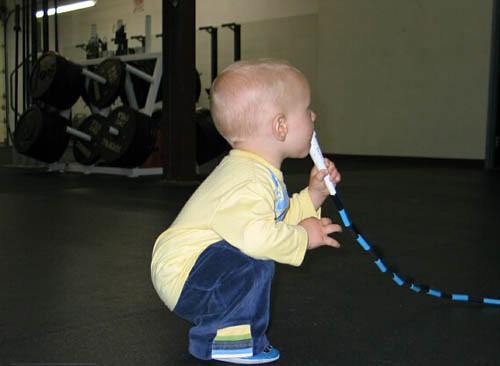
                Many have argued that the squat is not a safe or natural movement. If you are concerned, simply watch any young child pick something up off the ground. Perfect squat form! 

Photo by of willsansbury via Flickr


Photo by CrossFit Chicago, via Flickr

     You may have trouble with squats at first. Humans are meant to be able to squat down to the ground. Instead we spend all day sitting in chairs and never walking more than 10 feet without requiring some form of transportation. The result is that our hips and hamstrings tighten up as we age, to a point where squatting seems as foreign to us as, well, running.  Or jumping. Or anything we're supposed to be able to do but can't anymore because we're lazy.

     If you watch an Olympic weightlifter and a powerlifter squat next to each other you'll probably notice a lot of differences. Some prefer to keep their stance at shoulder width, while others prefer to place their feet much wider apart. Some hold the bar a little higher on their back, while others hold the bar a bit lower. 
    
     The only real limitation as far as where you hold the bar on your back is that if you get too high, you'll find that the bar starts to sit on your spine, which is definitely something to avoid.  The bar should always be on muscle as you hold it.

Olympic lifters:
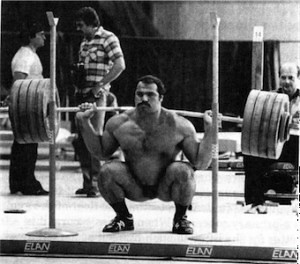
Photo: CrossFit Chicago via Flickr.
Photo: Maloney Performance


 Powerlifters:
Photo: Ironman Magazine

Photo: CrossFit Oakland


WHAT TO DO WITH YOUR BACK, KNEES, AND BUTT
     Now let's look at what all of these strong people are doing the same. They all push their knees OUT to the sides as they squat down. You may find while squatting that as you start to push yourself back up your knees start to come in towards each other. This is a big no-no. Push your knees out hard as you complete the entire lift. It may help to think of trying to push the floor apart under you with your feet.  As your hips get stronger, your knees will stay out on their own.
                  
     Another thing you'll see in the pictures is that the back is arched and the butt sticks out. A slightly arched back can hold more weight than one without an arch, and keeping an arch in your back will also tighten your core muscles and protect you as you begin to lift heavier weights.
     
     In the end, there are 2 simple thoughts that you need to keep in mind while squatting -- butt back, knees out. Start the lift by sticking your butt back like you’re trying to sit on the toilet, then push your knees out as if you have a gut and you need to make "room" for it between your legs as you squat down.

HOW DEEP SHOULD I GO? 
     One thing is for sure; almost everyone you see squatting at your local gym isn't going deep enough. The general rule for good depth is that you should go down to parallel. For our purposes, parallel means that the hip is at the same height as the top of the knee, resulting in the upper thigh being parallel to the ground. Focus on stretching every day, as well as keeping your knees out and butt back, and go as deep as you can. Eventually you'll find that you can reach parallel with no problems. If you want to get the most out of squats, there's nothing wrong with going even deeper than parallel.
 
      So, if our goal is to go as deep as possible, when do we know that we are going too far? Well, as you descend, eventually you'll reach a point where you lose the arch in your lower back and your butt begins to tuck under. This is known as "butt wink" in the lifting world, and it should be avoided. Do your best to stop just shy of this point, and you should be getting great depth in your squats.

                 DON'T be afraid to go deep. It's more effective to take a lighter weight and squat it deep with good form than to throw a ton of weight on your back and do half reps. In fact, this tendency to do super heavy half-squats is the main reason why squats got such a horrible reputation. When you stop half way down all of the pressure is put on the tendons on the front of the knee as you stop and change direction. If, on the other hand, you descend as far as possible, the pressure is evenly distributed throughout the entire structure of the knee. This leads to a healthy, strong knee that will allow you to be more active throughout your life.

 HOW MANY REPS SHOULD I DO?               
     So now that we know how to perform a squat, the only thing left to figure out is just how many squats we need to do. My suggestion to you is the keep your sets of squats at 3-8 reps. I know, this goes against most advice you'll get. Magazines will all tell you to do higher reps for "toning". Let’s talk about toning; it doesn't exist. 

4 things can happen when you exercise:

1. Your muscles get bigger.

2. Your muscles get smaller.

3. You lose fat.

4. You gain fat.

     I understand that it probably isn't your goal to get "big". Don't worry. Getting huge muscles doesn't happen accidentally. It takes years of effort with a focus on gaining size to get huge muscles, if it happens at all. Instead, what people usually refer to as "toning" is a combination of gaining a little muscle size while losing some fat. So don't be afraid to gain a little muscle size. This is part of the reason why I suggest lower reps per set compared with most conventional, fitness magazine-style advice. 

     Another reason to keep your reps lower per set is that you should NOT be going to failure with squats. This will lead to a severe breakdown in form that could lead to injury. The third, final, and most important reason I suggest lower reps is that it is MUCH easier to keep good form if you keep your reps under 10. You're going to get better results from 6 sets of 5 than you will from 3 sets of 10, because you'll be able to use a little more weight with better form, even though you'll end up doing the same number of reps.

Take Home Points

  • Keep the bar on muscle, not bone.
  • Start the squat by sticking out your butt, then descend by pushing your knees out to the side.
  • Go deep, but not so deep that your butt tucks under.
  • Keep your reps at 3-8 per set. 
  • Keep your form tight.
  • Don't push yourself to failure.


                Squats can be the biggest weapon in your exercise arsenal. They can reshape your butt and thighs into statuesque hunks of gorgeous Greek granite, and make your joints so healthy that you may be able to do super human feats, such as picking up a pen from the ground without having to hold onto a chair or table. Do you really need any more coaxing? Get to it!

Friday, February 1, 2013

Your Guide to the Weight Room: Form


[The FULL "form" portion of this series is going to be split up because I want to be thorough and give you enough examples and information. My husband is also ghostwriting each post for me and he has a full-time job, so it may take a little longer than I expected. (Does it count as ghostwriting if I tell you he's doing it?) Anyway, here is the intro and some links to great sites for female lifters.] 

Instead of wasting your time with "butt boosters" and "slimming swirls" (true story, those are actual "moves" published by Fitness Magazine. EYE. ROLL.) or doing 100 reps of bicep curls with 3lb. weights, there are THREE moves you can do that will activate all major muscle groups, and you don't need to be a professional choreographer to figure them out.

Cut your time at the gym while getting a full-body workout with squats, deadlifts, and bench press. Each exercise activates most (if not all) of your major muscle groups. This is something you will not get from machines. The reason there are 1000 machines at the gym is because they all focus on ONE muscle. What a waste of time. As long as you use proper form, the "big three" are all you need to get started in the weight room.

Some of my favorite "Motivation Inspiration" sites:
The Petite Athleat
Real Girls Lift Heavy
Elite FTS training logs (I <3 their pics/videos!)
     Jennifer Petrosino
     Molly Edwards
     Hannah Johnson
     Julia Ladewski

These girls all lift competitively, they are all strong, and they are all real. Everyone starts somewhere, and these chicks inspire me to keep getting stronger so I can end up far far away from where I started.

What gets you motivated to work out? Videos? Pictures? Quotes? Music?

Obligatory disclaimers:

*If you are working with free weights for the first time, practice in the mirror with no weight at first, then start the lift with just the bar. And PLEASE use a spotter!

*Yes, some of the videos in the links are of girls lifting really heavy weights. PLEASE don't let that intimidate you. The idea is to watch their form. Good form should be the same regardless of your height, weight, age, or gender, and whether you are warming up with an empty bar or going for a max.

*I am not a fitness professional. I just play one on the Internet. 

*I am not a doctor. I cannot diagnose or fix your aches and pains.  

*The information presented in this blog is for your entertainment and should not be used in place of medical advice. Use your common sense when making choices regarding your health and safety. Please and thank you. ;)

Monday, January 28, 2013

Your Guide to the Weight Room: Equipment


I'll admit, the first time I walked into a weight room without my husband, I was overwhelmed and pretty intimidated. I felt like I was walking into a forbidden, exclusive club and that the proverbial record would scratch, all the big sweaty boys would stop what they were doing and turn their heads to look at the poor little girl who was obviously lost.
I waited for someone to tell me that the aerobics room was on the other side of the gym or ask me where my mommy and daddy were. None of that happened. Everyone was too busy listening to Mudvayne on their iPods and checking out their sweet biceps in the mirror to even notice I was there. I even made a few friends. Guys started asking me about my routine and making small talk and eventually everyone knew who I was and I was more comfortable there than any other part of the gym. Not so scary after all.

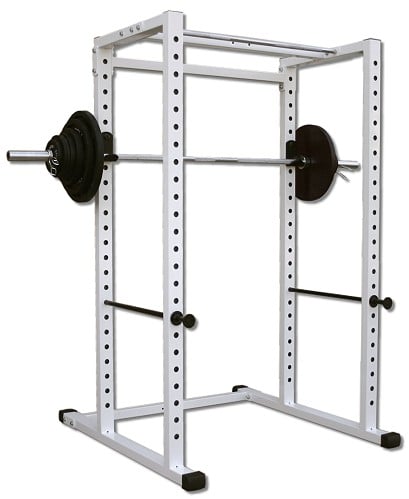
If you want to avoid the initial shock that I endured upon your first visit, you need to know about three pieces of equipment: the squat rack, the power rack, and the bench. There will be a lot of other junk there, but most of it is really just that. Junk. For the love of fluffy kittens, avoid the Smith machine at all costs! Not only is it completely useless, but it doesn't allow you to move the way your body naturally should. DO NOT use it. Please? That is the only thing I beg of you. (That and not doing 100 reps of bicep curls with 3lb. weights.)


M Squat Rack - www.torquehq.com

Squat Rack: Squats are one of the best exercises you can do for your body. Not only do they improve lower body strength, they also help you develop coordination and balance that will serve you well in any athletic endeavor. Also, they'll give you a great ass.
     You can place the bar at a comfortable height. (It should be just a tad lower than your shoulders when racked.) The safety rails will catch the bar if you need to "bail" (or drop the weight). They ensure that you don't hurt yourself or break any of the equipment. Trust them! As your form improves and you start to push yourself to lift heavier, you can rest assured that you won't kill yourself. In five years of doing barbell squats, I have never needed to use the safeties, but I feel better going bigger because I know they are there. 


Power rack - www.nerdfitness.com


Power Rack: The power rack is like the squat rack, but the rack and safety rails are completely adjustable so you can use it for multiple exercises. (Or if you are a shorty like me, you may prefer to squat and bench press here because you can customize it to your comfort.) Again, the safeties are there for your benefit. And if you fall backward (which is extremely rare, but IF!) the weights are completely contained and can't pin you.

Weight Bench - www.workouthealthy.com

Weight Bench: There's not much to it. The rack is adjustable, again, so you can place it at a comfortable level for you. You should be able to get the bar off the rack without rounding your shoulders or really "reaching" at all. Another request: regardless of what the bros in Tapout shorts are doing, DO NOT put your feet on the bench. This is a weak and unstable position and will become very dangerous once you start lifting heavier weights.

Like I said, don't worry about any of the other equipment. I promise this is all you will need, at least at first. And this may be an unpopular opinion, but I'm right so I don't care, but DO NOT pay for a personal training session. I'm sure there are reputable personal trainers out there, but most of them will teach you whatever cool things they learned in Men's Fitness and overwhelm you with jargon. If you aren't dependent on your trainer, you stop booking sessions and they don't get paid. I'll talk about form with you in the next part of this guide, and lead you to some sites with good videos and good advice for female lifters.


Tuesday, September 4, 2012

Reaching Pre-Pregnancy Weight

As someone who was in pretty decent shape before getting pregnant, I have been extremely impatient with myself when it comes to exercising, my weight, and most of all my shape. I mean, I popped in the P90x DVDs when my daughter was two weeks old. And then a couple weeks ago, I attempted a Sugar Detox (as you may have read.) I operate in extremes. That is why things like minimalism and Paleo appeal to me. But as a breastfeeding mama, I have to remember that--even though her 41 weeks of incubation are in the past--I still share my body with my baby. I need to keep her in mind when making changes to my diet or routine. By trial and error, here are some things I've learned so far:

DON'T
- Be too hard on yourself. YOU JUST HAD A BABY! It took 9+ months to grow a human. Nobody expects you to lose all of the baby weight overnight. You shouldn't either.
- Make excuses. Although you should pace yourself, don't use your baby and lack of sleep and time to yourself as an excuse to neglect exercise or eat poorly.
- Make any extreme changes right away. You can't pretend like your pregnancy never happened. Give your body some time to adjust before jumping in. This is especially important if you are breastfeeding since any major changes in diet or activity can negatively affect your milk supply. (Kellymom.com has some great tips for lactating moms interested in dieting.) Most importantly, do not cut calories if you are breastfeeding. In fact, you should stay about 400-500 above your maintenance calorie intake. But, of course, that doesn't mean hitting up the drive thru on your way home from the post office.

DO
- Maintain flexibility. You may not get to the gym at the same time every day. You may not get to go as often as you'd like. And if you can't go at all, there are other ways to stay active when your day doesn't go the way you planned. (I'll expand on this in my next post.)
- Drink enough (not an excess of) fluids. Water and other healthy beverages will help get rid of initial post-partum swelling as well as keep you hydrated since you will lose a lot of fluids in the first few days. This is especially important if you are breastfeeding since dehydration can decrease your supply, but a good tip for overall health nonetheless.
- Continue to eat healthy. (I will elaborate on this in my next post as well.) Don't give up on your body! You will not be soft and puffy forever, but you may have to work a little harder to get to where you want to be. Throwing on some sweats any chowing down on a half-gallon of Edy's is not the way to do it. But you're not stupid. You already knew that. ;)
- Be patient and stick with it. Even with hard work, it may still take 9-12 months to lose all of the baby weight. Not only do you deserve the happiness that comes with a healthy and active lifestyle, but now you have a child that deserve a mommy that can keep up and (most important of all) set a good example!

Friday, August 10, 2012

Sugar Detox - Day 1

Let the baking begin!

So thanks to a donation from an awesome friend, I have the official 21-Day Sugar Detox eBook! Today, I am pre-making my egg muffins and burgers which will be breakfast and lunch for the week. (Unfortunately, it's apparently really difficult to get bison on short notice here, so these burgers will be lean ground beef and ground turkey.) For snacks, I'll be baking up some kale chips and making some homemade applesauce in the crock pot. The number one "excuse" I have for not following through with this plan is that I don't have time to cook or make my meals. If I can get a week's worth of breakfast, lunch, and snacks done in one day, I'll be in good shape. The eBook has some really great recipes and meal ideas. I can't wait to try more!

I loosely followed the recipe from The Food Lovers Kitchen. I didn't have any broccoli or peppers, so I just sauteed some spinach. Next time, more veggies!

Minimal (love it!) clean up. I used a shaker bottle to scramble the eggs. Way easier than using a whisk and bowl.

Well, they're not pretty. Next time I will skip the liners and just coat the tin with some coconut oil. I will also lower the temp, because this is what they looked like at 15 minutes on 400. I'd say they were a success. I can definitely eat one of these for breakfast every morning, but I'd need to add something else to my meal in order to be satisfied.


Today is also my first day back to the gym in a week. I had a nasty ingrown toenail cut out last week (TMI? I know you want pics!) and it's still healing, so I'll be doing some lifting but keeping weight off of my foot, and then I'll be starting my 5/3/1 schedule over again on Monday. *sigh* Setbacks happen, people. You just have to keep trucking!

Tuesday, July 24, 2012

Getting Back in Shape

I was in great shape before I got pregnant. My husband and I did a round of P90x after our wedding and I lost 10 pounds. We cut out carbs, alcohol, and ate most of our meals at home.
I started powerlifting with the goal of competing initially at the novice level. Just when I had gained the strength and momentum to start getting serious about competition, I broke my finger (putting up a 50# dumbbell...) and was in a cast for two weeks. Soon after, I got that BFP! 
The day before I broke my finger.
My midwife insisted I could continue my exercise routine until I told her that included benching, squatting, and deadlifting more than my body weight. I was then told that I was limited to lifting 20-25lbs. Apparently, it wasn't safe for me to do more than 20% of my lifting capacity, but girls who have only ever done 5-10# curls and tricep extensions could continue at the same level and even quadruple their load if they wanted to... *major eyeroll*
I was terrified of a miscarriage, so even though I had done enough research to reassure myself that I could continue lifting as long as I felt comfortable, I decreased my load dramatically. I cut deadlifts completely, dropped my squatting weight to 75#, and only did incline bench presses with 25# dumbbells.
At six months pregnant, I cut strength training almost completely and reduced my routine to walking around the neighborhood. I was swollen, hot, and uncomfortable. It was all I could do.

Six months pregnant.
41 weeks pregnant and wider than I am tall... (The day before I gave birth.)


 Looking back, I regret not trusting myself and continuing to lift, but this was my first baby, and I was nervous. Now I am paying for it. My little girl is 11 weeks old and I have only lost about half the baby weight. I have 12lbs to go to my pre-pregnancy weight, and about 15-20 to my ideal weight. How am I going to get there? For starters, I'm back at the gym three days a week and it feels great! Before this gets anymore tl;dr I will end it here and share my routine another time. 
The only post-partum picture I could find. Me and Monkey Girl, 2 months old.