Background

Showing posts with label donations. Show all posts

Tuesday, October 30, 2012

Adopt-A-Platoon

Photo by vastateparksstaff, via Flickr


Before my husband even considered joining the Army, I was working in an 8th grade English class. Motivated by a conversation we had with the students regarding Veterans' Day, the teacher adopted a platoon on behalf of our classes. We had only two responsibilities: write letters every week, and send one care package a month. The results were so inspiring, I adopted my own platoon when I became a high school English teacher.

(I really want to share our amazing stories with you, but first I want to tell you how you can support our troops!)

Adopt-A-Platoon is a fantastic organization. They really have their youknowwhat together when it comes to matching you up with a soldier (or marine, sailor, or airman--all branches are supported) or unit, they make if very easy for anyone to participate, and they are extremely clear about the rules of the organization and laws regarding OPSEC. Seriously, I knew nothing about the military, or even sending packages overseas for that matter, and had a ton of questions before I signed up. Their website is so thorough and intuitive, I never had to look very far for answers, and when I did have to send an e-mail, the responses were quick, personal, and just as thorough.

Even if you don't have 150 middle school students to help you write letters every week, you can still make a difference:


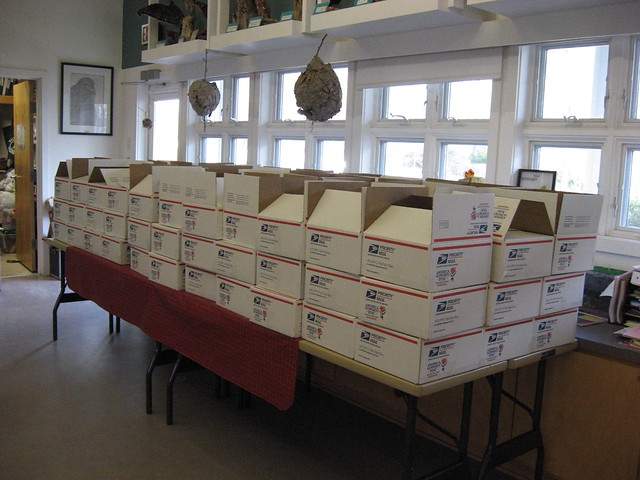
  • Adopt a soldier! As an individual or small family, you can adopt up to four troops. You'll be asked to send at least one letter or card a week and one care package per month. 
  • If you feel that you will be unable to send a care package, you can sign up as a pen-pal and send a weekly card or letter. A lot of soldiers don't have access to national news or current events outside of their job, so they like to hear about what's going on "back home." We always ended up sending the sports section of the local paper with our letters along with updates on upcoming movies, celebrity gossip, and other trivia.
  • If you want to send a single care package, you can sign up specifically for a one-time campaign, like Operation Holiday Eagle or Stockings for Santa.
If you would like to involve your church, company, school, youth group, or other civic organization (Rotary, Kiwanis, Boy/Girl scouts, etc.) I urge you to consider adopting a platoon. You will be in touch with a Point-of-Contact (POC) for the unit, and there is no guarantee you will hear back from the troops, but we always did!
     The first time, we were sent a flag, pictures, and letters from individual soldiers as well as information and a brief history on their specific unit. It was a GREAT learning experience for our students. A lot of them left with a new perspective on the military and even a new sense of self, realizing that a lot of the soldiers with which they communicated were very much like them. 
     The second time, our POC actually sent us a weekly newsletter (which I read to my 11th grade classes) and they loved that he commented on their letters! Once the deployment ended, he actually took a "Thank You" tour around the country to personally meet and thank everyone that supported his unit. He came to my classroom and spoke to my students! (He also took my husband and myself out to dinner *twice*. Not to brag, but how cool is that?! And as a new military spouse, the information and advice I received from him and his wife was absolutely invaluable.)

If you are looking for a way to teach your children about giving back this holiday season or you just want to support our troops, please check out Adopt-A-Platoon.

*It may sound like an advertisement, but I was not compensated or even asked by anybody to write this post. I believe strongly in supporting our troops, and AAP truly is a wonderful organization.

Tuesday, October 2, 2012

What do I do with this stuff?

I've been going through boxes in the garage to decide what is and is not going to Texas with us on the PCS. For the most part, I'm not having trouble deciding what stays or goes. I mean, we will definitely not be needing a full set of martini glasses or a multi-purpose cake plate, and since they're fragile, they probably wouldn't make the trip anyway. My biggest problem is what to do after I decide to get rid of things I no longer have a use for.

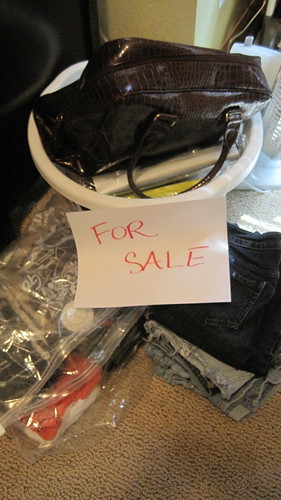
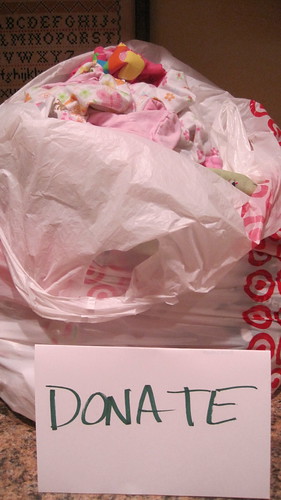
There are three main categories for these items: Trash, Sell, Donate.
Trash: This one is pretty easy. Either something is broken, dirty, or otherwise unusable. (Don't forget that some "trash" can be recycled!) No-brainer there.
The next two get tricky. How do you decide something is worth selling? Where do you plan to sell it? Is it worth the trouble? If not, and you decide to donate it, where will you take it? Are you worried about the likelihood of it actually being used?
Sell: This requires more work on your part than making a donation. You have some options, but try to keep it simple.
     You can have a yard sale, but be realistic. Will you really get up at 6AM on Saturday and Sunday to set up your items? Are you willing to haggle with people and accept the fact that you probably won't sell much? If you think a yard sale is a possibility, make sure you sufficiently advertise and see if any of your neighbors would like to get involved. (I'll talk more about yard sales in a later post.)
     If you don't want to give up your sleep-in days, consider listing items for sale online. You can list most items on Craigslist (for free!) or eBay. If you have books, video games, or DVDs, you can list them on half.com or the Amazon marketplace. ***Be sure to check each site's policies and listing fees.***  The pros here are that you don't have to physically haul your stuff in and out of your garage or worry about severe weather. Cons? It still takes time, and you have to be accurate with your descriptions. Either way, this stuff is still taking up your space until it's sold.

The best solution I've come up with here is narrowing down your options and forming a plan for the stuff that doesn't sell.
Scenario 1:
     I decide to have a yard sale. I advertise on Facebook, in the newspaper, and on Craigslist for a week. I make between $100-$500. Whatever is left over gets donated to the Salvation Army. Whatever they don't take goes in the trash or gets recycled. Done!

Scenario 2:
     I have a lot of books and DVDs to sell, so I post them on half.com. (I also advertise these listings on Facebook and any relevant online forums/communities.) If they don't sell by Christmas, they get donated. The end!

If you're more worried about recouping your space than your money, I'd say donating everything is the way to go!

Wednesday, August 29, 2012

How to Sell Cloth Diapers

*SOLD*


One of the main reasons I decided to use cloth diapers was to save money. Kelly Wels has a great calculator that shows your savings for one year using cloth vs. disposables if you need a visual. One added bonus I hadn't initially considered was the possibility of resale. Not only do disposable diapers cost you (and the environment) more in the long run, but nobody wants your dirty Pampers. The cost of cloth diapers, however, can be partially recouped.
People choose to sell diapers for a variety of reasons. Maybe a style didn't work for them (like prefolds for me) or a certain brand didn't fit their little one properly (my Monkey has thunder thighs).  Otherwise, people attempt to streamline or "destash" because they simply have too many diapers. The value depends on the condition and quality of the diaper, of course.

Since I've just earned my first $100 reselling some used cloth diapers, I thought I would share a few tips.
  1. Inspect the diapers you plan to sell. Look for stains, aplix/snap/elastic issues, pulls in the fabric, or general wear. 
  2. Determine the condition (New, EUC, VGUC, or GUC - you generally won't make any money off of diapers unless they are at least in good condition.)
    • New (never washed or used)
    • EUC (washed and/or used once or twice, practically new)
    • VGUC (used infrequently or in a large rotation, little to no wear)
    • GUC (used regularly, shows some signs of wear)
  3.  Find a venue. I've had success with CraigsList (in a very small, very non-crunchy town no less) and DiaperSwappers.com. You can also check Facebook for swap groups in your area.
  4. Be honest and thorough in you descriptions. It is better to get less money than you think a diaper may be worth than to deal with the headache of unhappy buyers--especially if you are selling online and going through PayPal. I try to avoid disputes, refunds, and negative feedback at all costs, but maybe that's just me. ;)
  5. Compare to other listings of the same or similar-quality diapers in the same condition in order to come up with a fair price. (Example: A Sbish fitted is going to sell for more than a GMD fitted because of the initial retail price, materials used, and perceived value to buyers.) 
  6. Some sellers including shipping costs in your price (listed as PPD - Postage Paid Domestic) out of convenience, but you may choose to quote shipping depending on the zip code of your buyer. I've personally found there is very little difference in shipping cost based on zip code unless you are sending packages OCONUS, so all of my prices are PPD.
  7. Try to sell in lots as opposed to listing individual diapers. Group by type (prefolds, pockets, AIOs, hybrids) or size (NB/XS, S, M, L, One-Size, or Size 1/Size 2) if you can. You'll get rid of more diapers and save on shipping this way.
  8. Consider shipping costs and PayPal fees when listing online. Some sites also require you to include Delivery Confirmation. You can get an inexpensive postal scale from Amazon and reuse mailers/boxes so there are no surprises at the post office!
  9. Have a back-up plan. If your diapers don't sell, you can store them for future babies or see if a shelter, foster home, or day care center in your area would be interested in donations!  Sites like Giving Diapers, Giving Hope also accept donations for families in need.
Happy diapering, mamas!

Tuesday, August 28, 2012

To Sell or Not To Sell


One particular trap I believe most people fall into while trying to declutter is the "But I can sell this!" trap. I know I do. Who has clothes in their closet with the tags still attached because it was cute and/or a great deal? I have at least one dress that fits this description. It was on sale, my favorite color, and it made my butt look phenomenal. I have yet to wear this dress. Partly because I got pregnant shortly after I bought it, but also because I have nowhere to go all dressed up! (This is another trap -- The "Someday!" trap -- but I'll save that for another post.)
Nothing provides a clearer visual of throwing away money like getting rid of something brand new and, if you're like me, you HATE that! So what do we tell ourselves? "I'll sell it!" While there is nothing wrong with attempting to recoup a piece of your original expense, there is one question you always need to ask yourself before you make that decision:
Is it worth it? Is it worth the time, effort, and maybe even more money to try selling an item?
In order to list something for sale on eBay, CraigsList, or any other online auction/classified/swap website you need to:
  • take and upload pictures
  • calculate shipping
  • have shipping supplies on hand
  • maintain and update your listing 
  • respond to any contacts from potential buyers
  • make a trip to the post office or meet up with your buyer
  • pay shipping/eBay/PayPal fees
Yard sales are an even bigger pain. For one of those you'll need to:
  • advertise your sale at least a week in advance
  • set prices for each item
  • get up REALLY early (my biggest issue)
  • physically haul out everything you're planning to sell
  • haggle with people who want to pay you a nickel for a garbage bag full of clothing
  • drag everything that doesn't sell back into the garage or house

In other words, are you willing to go through the trouble to list every single Beanie Baby you've ever owned to possibly make $5 a piece? What if they don't sell? Do you look forward to the physical demands of a yard sale when it's possible you'll end up with $100 and a horrible farmer's tan at the end of the day?
Remember, the goal here is still to minimize your clutter and get rid of STUFF. If you have listed items for sale online or plan a yard sale, you need to have a back-up plan for the items that remain when the party is over. How long do you give yourself to sell before it's time to just donate? You have to set a deadline! For the items I just listed (a ton of shorts, jeans, and pants that no longer fit since pushing a person through my pelvis has widened my hips) I am giving myself 30 days. After that, I am off to Goodwill to make another donation. Otherwise, things sit around and take up my valuable space which is exactly what I am trying to avoid.
Not to get off on a tangent, but that reminds me of the Storage Wars-type shows where they buy junk and then they show us their "profit" even though they haven't sold anything yet! Just because that old gas station sign is worth $300, you don't get the $300 until you sell it! Don't count your chickens, people. You may think something is worth a lot of money, but it's really worth nothing if nobody is willing to buy it from you. You are better off donating what doesn't sell instead of waiting for someone to come along and pay you for it. A clutter-free home is priceless!

Tuesday, July 31, 2012

Making Donations


I mentioned in my last decluttering post that I dropped off several bags of clothing to Goodwill. I don't have any personal affiliation or preference for charitable organizations. As far as I'm concerned, they are all (at least if they are legitimate charities) in existence to provide assistance to people who are in need, whether it is after a tragic event or a lifetime of struggling. You may prefer to donate to a charity that contributes to a specific cause, church, or local group. I highly recommend checking with the Google Fairy to find a local organization that is in line with your beliefs if that is the case. That way, when you donate, you may feel more motivated because you are not just getting rid of stuff, you are giving to a cause you believe in.

A few helpful tips for making donations:
  • Get a receipt if you plan to claim your donation on your taxes. Make a reasonable estimate of the value of the items you are donating. Be sure to not overestimate, lest the IRS come to question you about that $3000 teapot you generously donated to the Salvation Army. If you do wish to claim over $500 in donations for the year, contact a tax adviser to find out what forms you will need to fill out.  Goodwill and the Salvation Army both have guides available to help you get an idea of what your items are worth.
  • Find out if any local charities will pick up in your area. Also, find out what they will pick up. Some will take whatever you have, others will only take large items like furniture, heavy equipment, and vehicles. Another consultation with the Google Fairy is in order here, as even with larger organizations like the Humane Society and Habitat for Humanity, policies may vary from city to city.
  • Make sure your items are in clean and in useable condition. It is unfair to include damaged or dirty items in your donation. Please remember that most organizations are run by volunteers; don't waste their time by forcing them to throw away your garbage. 
  • If you have a large donation to make, you may want to call ahead to find out if the local store has room for your stuff. It would really suck if you loaded up a truck full of household goods to drop off only to be turned away at the door, wouldn't it?
  • Finally, be sure you are donating to a legitimate organization. They should have a tax ID and be willing to give you a receipt. If not, you may want to take your goods elsewhere. 
Enjoy clearing out the clutter, guys. It feels just as good to unload a bunch of unwanted junk as it does to buy it, and it costs much less. ;)